News
A2025-06-17
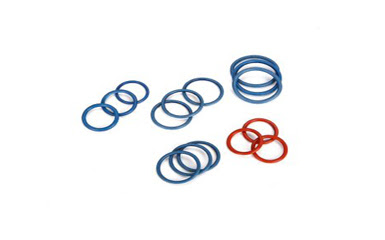
As a manufacturer with 31 years of sealing technology expertise, we understand PV seal rings are not ordinary rubber components—they must protect equipment for 25 years under desert UV, coastal salt spray, and Gobi sandstorms. This article reveals how four core competencies (material formulation, structural design, smart manufacturing, and scenario customization) deliver zero-failure sealing solutions for the solar industry.
UV Degradation Cracking
Failure Consequence: Coolant leakage → PID effect
Solution: EPDM + Carbon black shielding layer
Validation: QUV 6000h ΔH<5 Shore A
Salt Corrosion
Failure Consequence: Aluminum frame electrochemical corrosion
Solution: Zn anode-embedded seal rings
Validation: 80% corrosion rate reduction (1000h salt spray)
Sand Intrusion
Failure Consequence: Guide rail jamming → 15% power loss
Solution: Multi-lip labyrinth + electrostatic flocking
Validation: IP6X certification (1m³ dust chamber)
Low-Temperature Brittleness
Failure Consequence: -40℃ installation cracking
Solution: Long-chain branched EPDM (Tg=-65℃)
Validation: >85% compression resilience at -50℃
Chemical Swelling
Failure Consequence: Seal expansion → frame deformation
Solution: FVMQ ester-resistant formula
Validation: ΔV<3% (1000h immersion)
1. PV-Specific Rubber Systems
| Material | Key Property | Application |
|---|---|---|
| High-weather EPDM | Ozone resistance >1000 pphm | Module frame seals |
| Fluorosilicone | Ester solvent resistance | Inverter coolant lines |
| TPE-S | Laser weldable (+50% efficiency) | Junction box seals |
| Conductive silicone | Surface resistance 10³ Ω | Tracker control boxes |
Core Formulation Tech:
2. Eco-Certifications
1. Scenario-Adaptive Structures
2. Digital Design Tools
1. Quality Control Nodes
| Process | Precision Control | Defect Rate |
|---|---|---|
| Mixing | Mooney viscosity ±3% | <200 ppm |
| Molding | Temp ±1℃, Pressure ±0.2 MPa | <100 ppm |
| Surface treatment | Plasma >50 mN/m | <50 ppm |
| Inspection | 3D vision ±0.05mm tolerance | <10 ppm |
2. Rapid Response System
Customized Solutions
LCOE Optimization Case:
FVMQ replaces NBR → Initial cost +0.003/kWh
1. Smart Seal Systems
2. Green Materials
3. Extreme Environments
| Scenario | Solution | Certification |
|---|---|---|
| Mars PV stations | Perfluoroelastomer (FFKM) | NASA validation |
| Nuclear PV zones | Radiation-resistant EPDM | ISO 10993-5 pass |
Epilogue: Convergence of Material Science & Scenario Engineering
At molecular level, nano-shielding defeats 25-year climate attacks;
Through structural innovation, AI enables lightweight efficiency;
Via distributed manufacturing, we support global PV deployment.
Transitioning from "seal supplier" to "PV reliability partner," we safeguard every percentage of conversion efficiency. Future evolution will focus on ultrathin seals (<0.5mm) and multifunctional integration (electrical/thermal/adhesive).
[DLSEALS kindly Reminder] Sealing issues? Turn to DLSEALS! As a sealing component manufacturer, we specialize in customizing sealing components, providing a full range of services from design, research and development, production, testing, and more. If you have more information you'd like to know, feel free to contact us directly. DLSEALS's product experts are dedicated to serving you!

GUANGDONG DLSEALS TECHNOLOGY CO.,LTD.
TEL/Whatsapp
:+86 15918359971ADDRESS
:No. 2 Niujiaokeng Road, Baizhoubian, Dongcheng District, Dongguan, Guangdong, China.