News
A2026-03-12
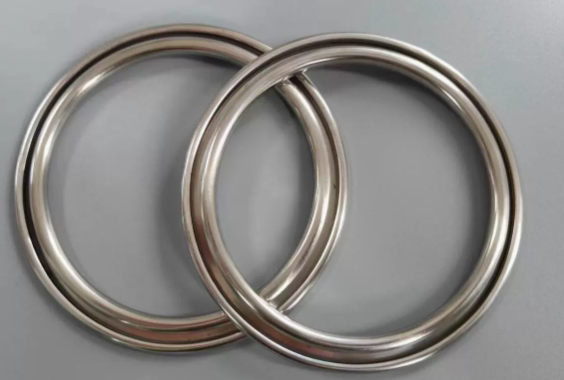
As shown in the image, metal seal rings for marine valves (also known as metal O-rings, hollow metal O-rings, or metal C-rings) are core sealing components in ship valve systems. They are primarily used in ball valves, butterfly valves, gate valves, check valves, and other critical marine valves. These seals provide reliable metal-to-metal or assisted sealing under extreme conditions such as high pressure, high temperature, seawater corrosion, vibration, and shock, ensuring zero leakage and long-term safe operation of valves on vessels.
The metal seal ring typically features a circular hollow tubular cross-section (wall thickness 0.2–0.8 mm). It is formed by bending metal tubing into a closed ring and then welding it (or using seamless forming). The example in the photo displays a smooth, mirror-polished surface with precise circular geometry, with ring diameters ranging from tens to hundreds of millimeters.
Key special structural features include:
These features allow the seal ring to maintain effective sealing contact even under installation tolerances of ±0.1 mm and thermal deformation.
The metal seal ring operates based on a dual mechanism of elastic deformation + pressure self-energization:
This principle makes it particularly suitable for marine applications with large pressure fluctuations and temperature variations (such as fuel systems, ballast water systems, and fire-fighting pipelines), significantly outperforming rubber or PTFE seals under extreme conditions.
Marine environments demand materials with excellent seawater corrosion resistance, high-pressure capability, and wide temperature range. Mainstream materials include:
Surface treatments often include silver plating (to reduce friction) or nitriding (to increase hardness to HV 800+). All materials must comply with classification society certifications such as ABS, DNV, CCS, etc.
Compared to traditional non-metallic seals, typical performance parameters of metal seal rings are:
In marine valves, metal seal rings are mainly installed in valve seat grooves or on valve ball surfaces. Installation requires strict control of groove dimensions (tolerance ±0.02 mm) and surface roughness Ra 0.4 or better to avoid scratching the coating. Common failure modes include:
Regular inspection via ultrasonic thickness measurement or pressure testing can detect issues early. Replacement must use original-specification, classification-society-certified products to ensure system safety.
Thanks to its unique hollow self-energizing structure, excellent high-temperature/high-pressure performance, and seawater corrosion resistance, the metal seal ring has become an irreplaceable core sealing element in modern marine valves. When selecting, match the appropriate material and structure to the valve’s pressure rating, medium type, and temperature range to achieve optimal sealing performance and longest service life.
[DLSEALS kindly Reminder] Sealing issues? Turn to DLSEALS! As a sealing component manufacturer, we specialize in customizing sealing components, providing a full range of services from design, research and development, production, testing, and more. If you have more information you'd like to know, feel free to contact us directly. DLSEALS's product experts are dedicated to serving you!

GUANGDONG DLSEALS TECHNOLOGY CO.,LTD.
TEL/Whatsapp
:+86 15918359971ADDRESS
:No. 2 Niujiaokeng Road, Baizhoubian, Dongcheng District, Dongguan, Guangdong, China.