News
A2026-05-20
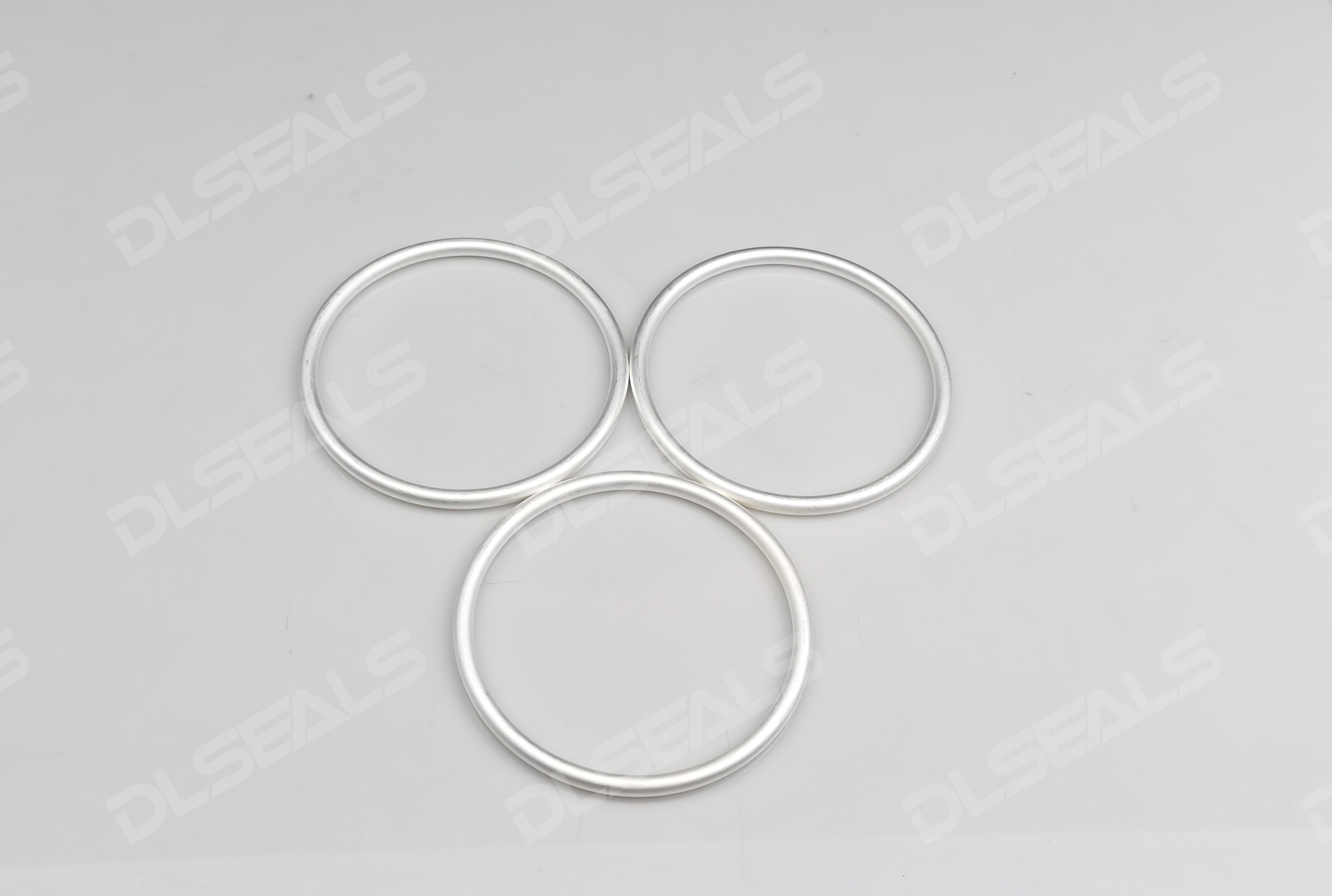
In humanity's journey to conquer the skies and deep space, every aircraft or spacecraft launched is a highly complex system composed of thousands of precise components. Within this massive system lies a frequently overlooked yet critical choke point that dictates the survival of the entire vehicle: the sealing components.
When conventional rubber or polymer materials prove completely helpless against the harsh, punishing environments of aerospace applications, Metal O-Rings step in as an irreplaceable line of defense, guarding the ultimate safety of aerospace missions.
In routine industrial or civil applications, rubber O-rings (such as FKM or silicone) are widely utilized for their excellent elasticity and cost-effectiveness. However, the operating environments in aerospace defy all "normal" standards:
Extreme Temperature Spans: Temperatures range from the near-absolute zero of liquid rocket propellants (such as liquid hydrogen and liquid oxygen) at $-250^\circ\text{C}$ to the scorching heat of rocket engine gas nozzles and turbine bearings exceeding $+800^\circ\text{C}$. Under such conditions, standard rubber would either freeze and shatter like glass or burn to ashes.
Space Vacuum and Radiation: In deep space, polymer materials suffer severe "outgassing" effects, causing the materials to degrade and break down. The released volatile molecules can easily contaminate high-precision optical instruments. Furthermore, intense cosmic radiation accelerates the aging of non-metallic materials.
Ultra-High Pressure and Severe Vibration: The violent mechanical overloads during rocket launches, combined with massive pressure fluctuations inside the engine (often reaching tens of MPa), demand sealing materials with exceptional mechanical strength that will never succumb to "cold flow" or extrusion under load.
Faced with these "no-go zones" for rubber, Metal O-Rings made of high-strength stainless steel, nickel-based superalloys (such as Inconel), or titanium alloys emerge as the definitive and only solution.
Metal O-rings typically utilize a hollow tubular structure (Hollow Metal O-Rings). Some variants are internally filled with high-pressure inert gases (gas-energized) or featured with holes in the tube wall (pressure-energized). This specialized design grants them the following hardcore performance advantages:
Unrivaled Temperature Thresholds: The metallic composition ensures superior thermal stability. Combined with advanced surface plating technologies (such as silver, gold, or nickel plating), they can function reliably over an ultra-wide temperature spectrum from $-270^\circ\text{C}$ to $+850^\circ\text{C}$, enduring the ultimate trials of frost and fire.
Flawless "Zero Outgassing" and Radiation Resistance: Being pure metal fabrications, they exhibit zero outgassing in ultra-high vacuum deep-space environments. They release no volatiles, maintaining absolute cleanliness for cutting-edge optical payloads like space telescopes and satellites. Additionally, their metallic crystalline structures are inherently immune to cosmic rays and UV radiation.
Exceptional Structural Resiliency and Self-Tightening Function: The hollow tubular design gives the metal ring a spring-like micro-recovery capability. As operating pressures escalate, pressure-energized metal O-rings leverage the holes on the tube wall to let the medium enter the inner cavity. This achieves a self-adaptive sealing effect where "the higher the pressure, the tighter the lip is pressed," perfectly accommodating microscopic flange misalignments triggered by high-frequency engine vibrations.
Ultimate Chemical Compatibility: Rocket propellants (such as hydrazine-based fuels, strong oxidizers, and liquid oxygen) are highly corrosive, volatile, and explosive. Stainless steel or nickel alloys exhibit near-perfect chemical inertia against these hazardous media, completely eliminating any risks of seal swelling, degradation, or dissolving.
Metal O-rings are deployed in the most vital and hazardous areas of flight vehicles:
Rocket Propulsion Systems and Liquid Rocket Engines: Fluid lines for liquid hydrogen and liquid oxygen, combustion chamber injectors, and gas valve control units. Here, they must withstand extreme cryogenic temperatures while enduring massive thermal shocks at the exact moment of ignition.
Aircraft Propulsion (Turbofan/Turbojet Engines): Fuel nozzles, turbine casing joints, and afterburner systems. This is the epicenter of high-temperature and high-pressure conditions, where metal O-rings ensure that fuel and high-temperature exhaust gases are strictly contained.
Onboard Hydraulic and Environmental Control Systems (ECS): High-pressure actuators, landing gear hydraulic control valves, and high-temperature bleed air ducting. They guarantee that hydraulic systems remain rock-solid when aircraft adjust their attitude at altitudes of tens of thousands of feet.
In the aerospace industry, the value of a metal O-ring has long transcended that of a simple "accessory." It carries immeasurable commercial and life-safety value:
Eliminating Catastrophic Risks: The 1986 Space Shuttle Challenger disaster was fundamentally caused by the failure of a booster rubber O-ring that lost its elasticity in cold weather, leading to a fatal fuel leak. This painful lesson proved that in extreme environments, a failure in sealing is the prelude to catastrophe. Metal O-rings minimize such material failure risks through their robust physical stability that remains independent of temperature fluctuations.
Extending On-Orbit Lifespan and Reliability: Once launched into orbit, satellites and space stations are virtually impossible to access for seal replacements or maintenance. Metal O-rings possess an ultra-long lifespan that is free from aging for decades, serving as the ultimate anchor for ensuring zero leakage in space station cabins and satellite propulsion systems over extended operational timelines.
Empowering Breakthroughs in Thrust-to-Weight Ratio and Efficiency: To pursue higher thrust-to-weight ratios, modern aero-engines continue to push combustion chamber temperatures and pressures to new extremes. The high temperature and pressure thresholds of metal O-rings untie the design constraints for propulsion engineers, allowing engines to run at higher thermal efficiencies and indirectly driving the technological evolution of aerospace propulsion.
From microscopic hydraulic valves to massive rocket combustion chambers, metal O-rings utilize their hardcore metal bodies to silently endure tons of pressure and thousands of degrees of scorching heat at the interface of frost, fire, vacuum, and pressure. They are not only the crystallization of modern material science and micron-level manufacturing precision but also the indispensable, indestructible "gate of safety" for humanity as we explore the universe and journey into deep space.
[DLSEALS kindly Reminder] Sealing issues? Turn to DLSEALS! As a sealing component manufacturer, we specialize in customizing sealing components, providing a full range of services from design, research and development, production, testing, and more. If you have more information you'd like to know, feel free to contact us directly. DLSEALS's product experts are dedicated to serving you!

GUANGDONG DLSEALS TECHNOLOGY CO.,LTD.
TEL/Whatsapp
:+86 15918359971ADDRESS
:No. 2 Niujiaokeng Road, Baizhoubian, Dongcheng District, Dongguan, Guangdong, China.