News
A2026-05-29
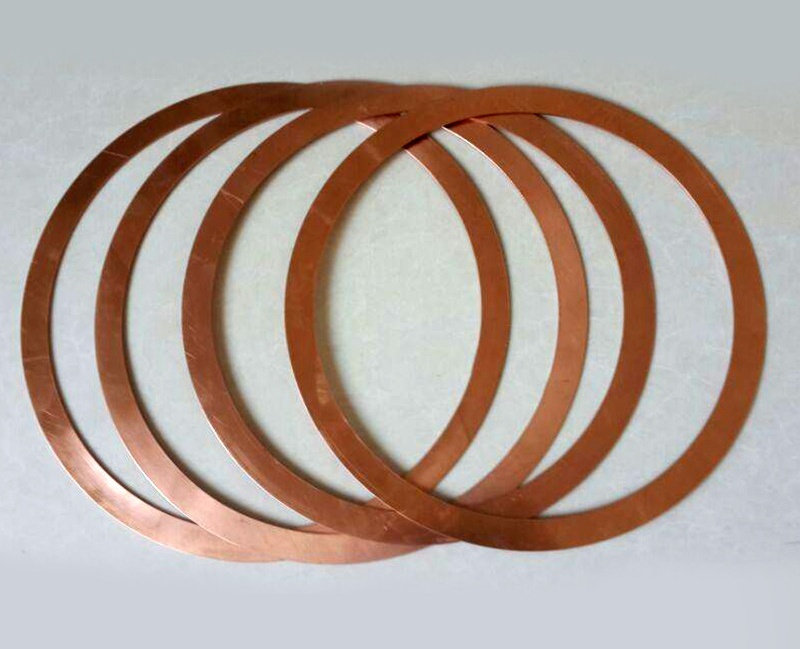
In modern industrial equipment, sealing technology is a critical factor in ensuring the safe and efficient operation of systems. Annealed copper gaskets, as a classic and high-performance sealing material, play an indispensable role in vacuum systems, engines, pressure vessels, and many other fields. Made primarily from pure copper and treated with a special annealing process, they combine the strength of metal with excellent softness and conformability, making them the preferred choice for many high-demand applications.
Annealed copper gaskets are mainly made from high-purity copper (such as T2 or TU1) or oxygen-free copper (OFHC). Copper itself offers excellent electrical and thermal conductivity as well as corrosion resistance. However, after cold working, copper sheets tend to harden and become brittle. Annealing is the key process that addresses this issue: the copper gaskets are heated to approximately 600–700°C, held at temperature, and then slowly cooled. This allows the crystal structure to recrystallize, eliminates internal stress, and significantly improves ductility and softness.
After annealing, the hardness of copper gaskets typically drops to 35–45 HB, with tensile strength around 22–25 kgf/mm² and elongation reaching 45–50%. This “softened” property enables the material to flow under pressure, filling microscopic irregularities on flange or joint surfaces for reliable static sealing.
The production of annealed copper gaskets generally includes the following steps:
Compared to non-annealed copper gaskets, the annealed version provides superior sealing performance, especially on surfaces with higher roughness or slight deformation.
Of course, they also have limitations: compared to graphite or composite gaskets, they may require higher preload under extreme pressure, and their cost is relatively higher. They are not suitable for strong acids, strong alkalis, or other highly corrosive environments.
Before installation, check the gasket for any deformation caused during transport and ensure it is clean. When tightening bolts, apply force evenly to avoid over-compression that causes excessive material flow. While some users perform localized heating with a heat gun or re-anneal in a furnace, professionally manufactured pre-annealed gaskets are more reliable.
After use, light surface oxidation generally does not affect sealing performance, but proper storage is recommended to prevent long-term exposure.
Though modest in appearance, annealed copper gaskets occupy an important place in the history of industrial sealing thanks to their unique combination of strength and flexibility. From ultra-high vacuum in laboratories to the powerful operation of heavy machinery, they silently safeguard the stability and safety of systems.
As materials science advances, copper gaskets may integrate with new coatings or composite technologies to further enhance performance. When selecting sealing materials, understanding the essence of annealed copper gaskets — imparting flexibility and vitality to metal through heat treatment — is key to unlocking their full potential. For applications that demand reliability and long service life, they remain a trusted core choice.
[DLSEALS kindly Reminder] Sealing issues? Turn to DLSEALS! As a sealing component manufacturer, we specialize in customizing sealing components, providing a full range of services from design, research and development, production, testing, and more. If you have more information you'd like to know, feel free to contact us directly. DLSEALS's product experts are dedicated to serving you!

GUANGDONG DLSEALS TECHNOLOGY CO.,LTD.
TEL/Whatsapp
:+86 15918359971ADDRESS
:No. 2 Niujiaokeng Road, Baizhoubian, Dongcheng District, Dongguan, Guangdong, China.