News
A2026-01-22
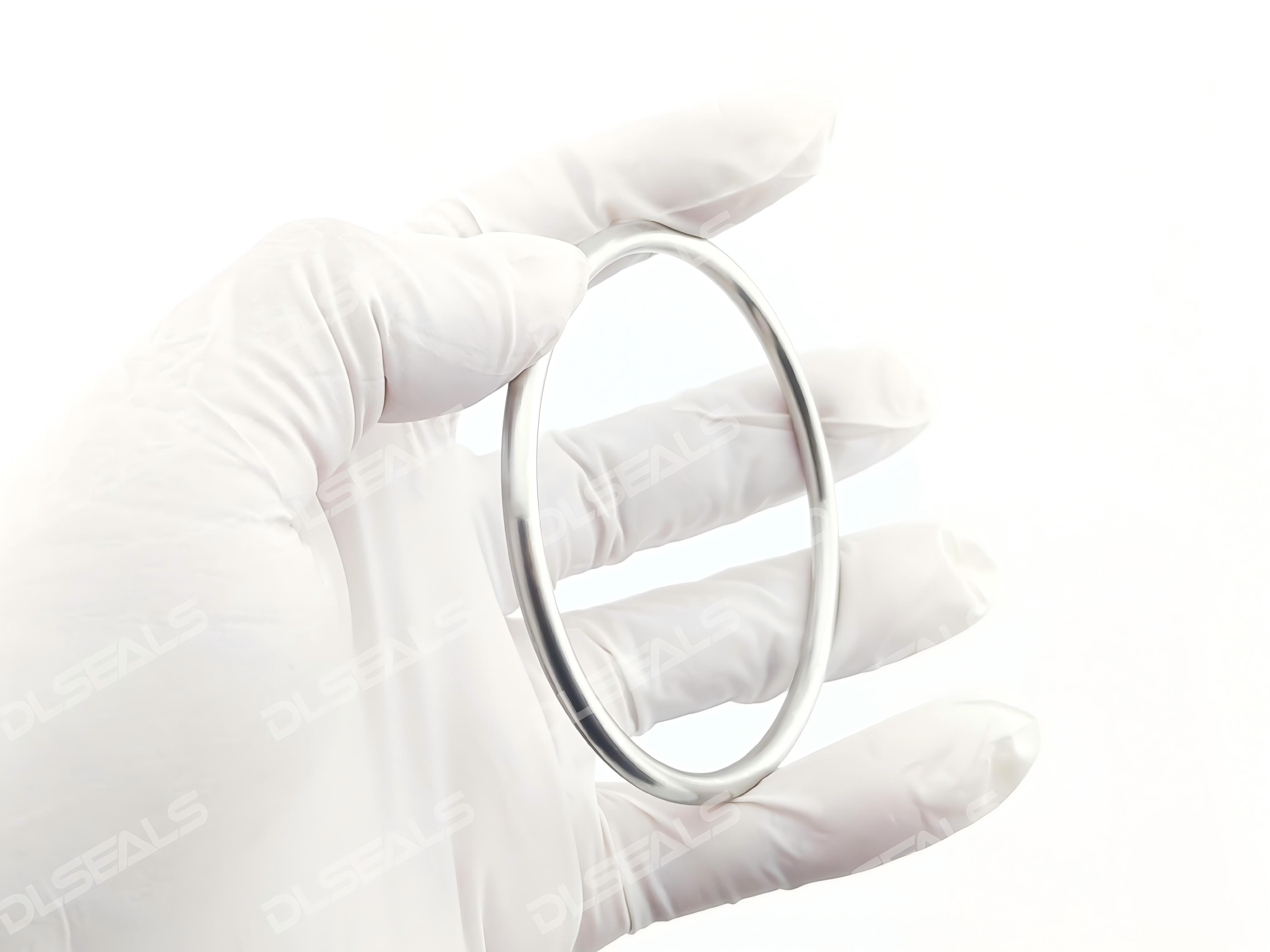
O-rings, as a common static sealing element, are widely used in flange connections, valves, and pressure vessels. At room temperature, rubber or polymer O-rings suffice; however, in high-temperature (>500°C) or extreme environments (such as vacuum, high pressure, or corrosive media), metal O-rings are required. Metal O-rings are typically hollow structures (e.g., C-type or E-type cross-sections) to provide necessary elastic deformation and resilience. Nevertheless, performance degradation of pure metal structures at ultra-high temperatures (>800°C) has become a bottleneck.
To address this issue, the industry has introduced ceramic fiber filling technology. This composite design fills high-purity ceramic fibers (such as alumina-silicate fibers) inside a metal shell, forming a “hard shell + soft core” structure. It retains the corrosion resistance and shape stability of the metal while leveraging the high-temperature elasticity and low creep of ceramic fibers to significantly enhance overall sealing performance. This article analyzes its core mechanisms and technical advantages in depth.
Pure metal hollow O-rings (e.g., made of high-temperature alloys such as Inconel 718 or Hastelloy C-276) rely on the elastic modulus and yield strength of the metal itself to maintain sealing stress. However, under high-temperature conditions, metal materials face the following challenges:
These limitations are particularly pronounced in extreme conditions (e.g., rocket engine combustion chambers or nuclear reactor cooling systems), prompting the development of composite material solutions.
The core of ceramic fiber-filled metal O-rings lies in compactly filling high-purity ceramic fibers (e.g., Al₂O₃-SiO₂ composite fibers, fiber diameter 5–10 μm, density 2.5–3.0 g/cm³) inside a tubular metal shell. The shell is typically made of high-temperature alloys (e.g., Inconel X-750), with a thickness of 0.5–1.0 mm, providing mechanical protection and shape constraint. Filling is achieved via high-pressure forming or vacuum impregnation to ensure uniform fiber distribution.
During installation, the O-ring is compressed, and the internal ceramic fibers provide the primary elastic support. The sealing stress can be approximately described by:
where is the sealing stress, is the preload force, is the contact area, is the effective fiber stiffness, and is the compression deformation. Compared to pure metal, ceramic fibers maintain a more stable at high temperatures, as their glass transition temperature (Tg) exceeds 1400°C with virtually no creep.
Additionally, the design offers vibration and impact resistance, suitable for dynamic sealing applications.
Potential challenges include fiber fracture risk (requires optimized filling pressure) and higher cost (composite O-rings cost 2–3 times more than pure metal).
Ceramic fiber-filled metal O-rings have been validated in multiple high-end fields. The table below compares performance of different O-ring types under typical parameters:
| Type | Temperature Limit (°C) | High-Temp Resilience (%) | Minimum Preload (MPa) | Typical Leakage Rate (Pa·m³/s) | Typical Applications |
|---|---|---|---|---|---|
| Pure Metal Hollow O-Ring | 750–900 | 60–70 | 20–50 | 10^{-6}–10^{-7} | General high-temp valves, petrochemical |
| Metal Spring-Enhanced O-Ring | 800–1000 | 75–85 | 15–40 | 10^{-7}–10^{-8} | Gas turbines, aero engines |
| Ceramic Fiber-Filled Metal O-Ring | 1000–1400 | 90–95 | 5–20 | 10^{-8}–10^{-9} | Nuclear reactors, rocket engines, ultra-high-temp furnaces |
For example, in SpaceX’s Raptor engine, such seals are used in combustion chamber flanges to ensure no leakage in oxidizing environments >1000°C. In nuclear power, they are applied in high-temperature gas-cooled reactor (HTGR) cooling loops, significantly reducing maintenance frequency.
Ceramic fiber-filled metal O-rings effectively compensate for the elastic deficiencies of pure metals at ultra-high temperatures through composite material design, achieving revolutionary improvements in sealing performance. This technology not only extends the temperature limit but also enhances system reliability and adaptability. With advancements in materials science (e.g., nano-reinforced fibers), its applications will further expand to even more extreme environments. Engineers should consider operating conditions, cost, and compatibility when selecting to optimize design solutions.
[DLSEALS kindly Reminder] Sealing issues? Turn to DLSEALS! As a sealing component manufacturer, we specialize in customizing sealing components, providing a full range of services from design, research and development, production, testing, and more. If you have more information you'd like to know, feel free to contact us directly. DLSEALS's product experts are dedicated to serving you!

GUANGDONG DLSEALS TECHNOLOGY CO.,LTD.
TEL/Whatsapp
:+86 15918359971ADDRESS
:No. 2 Niujiaokeng Road, Baizhoubian, Dongcheng District, Dongguan, Guangdong, China.