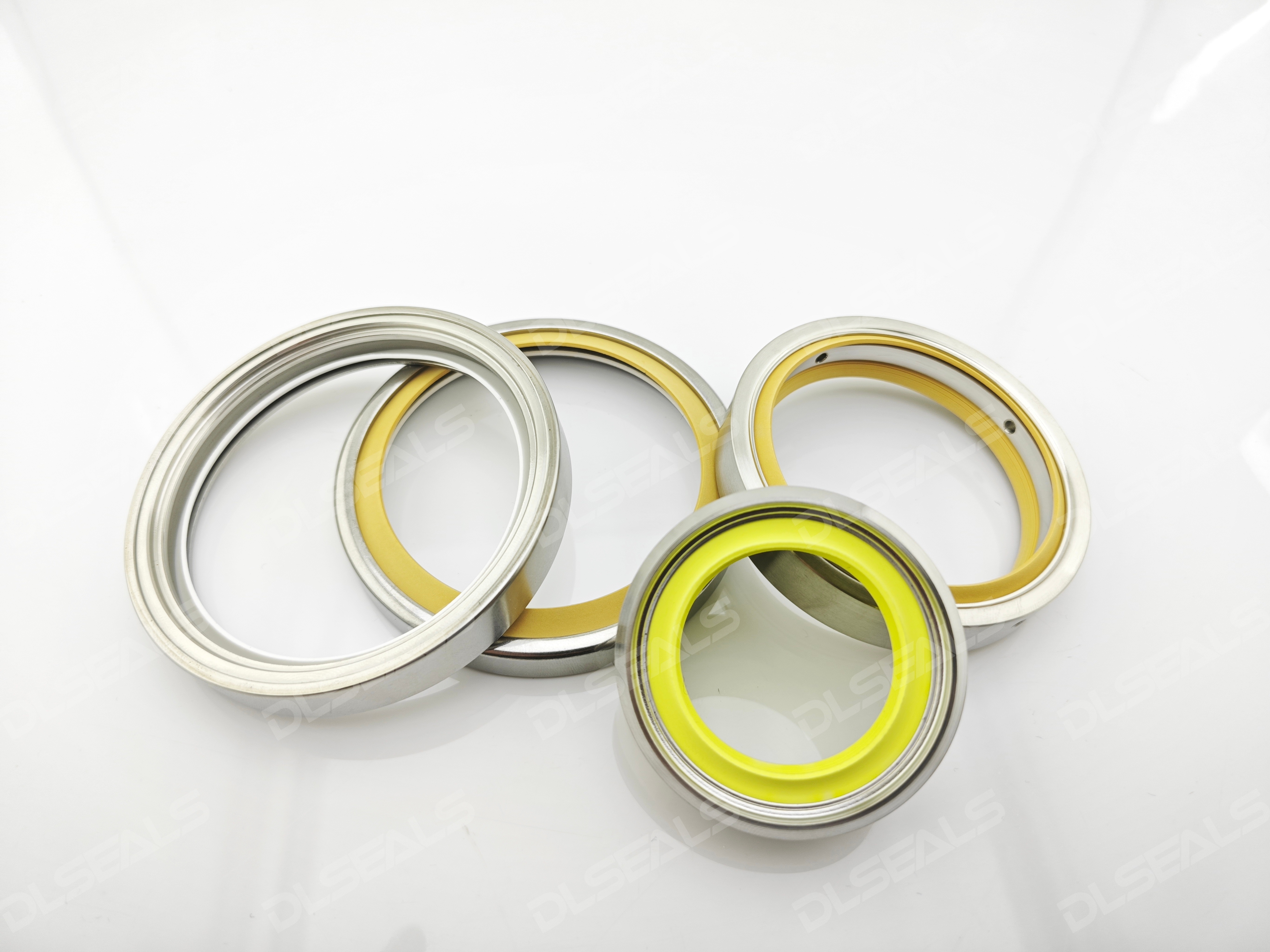
(The above image shows a typical series of stainless steel oil seal products, clearly displaying the exposed stainless steel skeleton structure and FKM lip.)
Stainless steel oil seals (Stainless Steel Oil Seals) refer to precision rotary or reciprocating seals that use stainless steel as the metal skeleton (or outer shell), combined with high-performance elastomer lips and stainless steel tension springs. Compared to ordinary carbon steel-cased oil seals, stainless steel oil seals (commonly made of SUS304 or SUS316) offer excellent corrosion resistance, fatigue strength, and high-temperature stability. They are widely used in food and pharmaceutical industries, marine engineering, chemical equipment, automotive engine valve stem seals, and high-end turbocharging systems. The manufacturing process is a typical precision rubber-metal composite molding technology. The core lies in achieving reliable chemical-physical bonding between the stainless steel skeleton and the elastomer lip, while ensuring lip geometry accuracy (±0.05 mm level) and consistent radial force. This article focuses on the manufacturing process of stainless steel oil seals, providing a professional and detailed technical analysis from raw material preparation, skeleton stamping, surface treatment, rubber compounding, vulcanization bonding, post-processing, to quality inspection. It aims to serve as a systematic reference for sealing component R&D and manufacturing engineers.
1. Raw Material Selection and Pre-treatment
The core raw materials for stainless steel oil seals consist of three main parts:
- Metal Skeleton: Cold-rolled stainless steel strip (SUS304/316, thickness 0.5–1.2 mm, tolerance ±0.02 mm) with no scratches or oxide scale. For complex valve stem seal skeletons, deep-drawing grade stainless steel is used.
- Elastomer: Selected according to operating conditions — NBR, FKM (Viton), ACM, or AEM. FKM is suitable for high temperatures (≤200°C) and fuel environments, with Shore A hardness 70–85°.
- Tension Spring: SUS304/SUS316 stainless steel wire (diameter 0.3–0.8 mm), formed into a Garter Spring to provide constant radial force (0.5–2.5 N).
Key pre-treatment steps:
- Stainless steel strip undergoes surface cleaning (degreasing, pickling) upon receipt to prevent oil contamination from affecting subsequent bonding.
- Elastomer raw materials require Mooney viscosity testing (ML1+4@100°C 40–80) to ensure uniform mixing.
- Spring wire is straightened and annealed to improve fatigue life.
2. Metal Skeleton Stamping and Surface Treatment (Skeleton Preparation Section)
This is the core process in stainless steel oil seal manufacturing, directly determining structural rigidity and bonding strength.
- Precision Stamping:
- Multi-station progressive dies or single presses (100–300 tons) are used for single or multi-stage forming of the shell and lip support structure.
- For complex valve stem seal skeletons, secondary fine blanking + turning/grinding ensures inner diameter tolerance ±0.03 mm and flatness ≤0.05 mm.
- Deburring (vibratory or electrolytic polishing) after stamping to avoid scratching the lip.
- Surface Treatment:
- Sandblasting/Shot Peening: Roughness Ra 1.6–3.2 μm to increase mechanical interlocking.
- Chemical Treatment: Phosphating (or manganese/zinc-based) + passivation to form a nano-level conversion film (thickness 5–10 μm).
- Adhesive Coating: Two-component Chemlok or silane coupling agent applied by roller, spray, or dip coating, dried at 120–160°C for 10–20 min. Adhesive thickness controlled at 10–20 μm to ensure interface shear strength >5 MPa.
Surface treatment of stainless steel skeletons is stricter than carbon steel because the natural passivation film must be disrupted and reactivated for rubber vulcanization bonding.
(The above image is a schematic diagram of contact pressure distribution in stainless steel oil seals, illustrating the influence of skeleton design on lip sealing performance.)
3. Rubber Compounding and Pre-forming (Compound Preparation Section)
- Mixing:
- Banbury mixer or open mill with two-stage mixing: first stage adds raw rubber, reinforcing agents (carbon black/silica), and antioxidants; after filtration, second stage adds vulcanizing agents (peroxide or sulfur system) and accelerators.
- Mixing temperature strictly controlled ≤120°C to prevent scorching. FKM mixing requires specialized low-temperature processes.
- Compound inspection: Mooney viscosity, hardness, tensile properties, and rheology curves (RPA).
- Pre-forming:
- Precision preformers (cold-feed extrusion + cutting) produce ring-shaped or sheet preforms with weight accuracy ±1%, matched to the skeleton shape.
- Traditional open-mill sheeting has been largely phased out; precision preforming can improve vulcanization yield by over 15%.
4. Spring Preparation and Assembly
- Stainless steel wire is coiled into helical springs using automatic spring winders, then formed into rings, stress-relieved by heat treatment, and cleaned.
- Premium products use laser welding or spot welding to fix spring position, ensuring uniform radial force (online inspection ±0.1 N).
5. Vulcanization Composite Molding (Product Vulcanization Section)
The most critical process in stainless steel oil seal manufacturing, using transfer molding or injection vulcanization:
- Mold Preparation: CNC-machined high-precision molds (HRC58–62), cavities chrome-plated or nitrided, surface roughness Ra≤0.4 μm. Mold temperature control accuracy ±2°C.
- Mold Loading: Stainless steel skeleton + adhesive + preformed compound + spring loaded automatically or semi-automatically.
- Vulcanization Parameters (typical FKM):
- Temperature: 180–200°C;
- Pressure: 10–20 MPa;
- Time: Primary vulcanization 3–8 min + secondary post-cure (150–200°C × 4–24 h) to remove volatiles and improve compression set performance.
- Vacuum Vulcanization: Modern lines use vacuum presses to remove air, reduce bubble defects, and increase bonding yield to over 99%.
Lip geometry accuracy is directly guaranteed by the mold; radial force is jointly controlled by the spring and lip design.
6. Post-Processing, Trimming, and Assembly (Finishing Section)
- Automatic Trimming: Laser or mechanical trimmers remove flash (flash thickness <0.1 mm).
- Secondary Vulcanization: Oven or continuous tunnel furnace to ensure complete FKM crosslinking.
- Surface Treatment: Some products receive PTFE low-friction coating on the lip (thickness 5–10 μm), further reducing friction coefficient to 0.08–0.12.
- Cleaning and Rust Prevention: Ultrasonic cleaning + rust-preventive oil spraying.
- Assembly: For composite seals, final spring insertion and lip positioning.
7. Quality Inspection and Control System
100% online inspection + sampling destructive testing throughout the process:
- Dimensional Inspection: Fully automatic optical image measuring instruments (CMM) check skeleton inner/outer diameter, lip diameter, and lip thickness.
- Bonding Strength: Peel test (≥5 N/mm).
- Radial Force: Dedicated radial force tester (new part 1.0–2.0 N, tolerance ±0.2 N).
- Sealing Performance: Vacuum leak test (leakage rate <0.1 g/h), bench rotary/reciprocating durability test (>2,000 h, high temperature and pressure).
- Material Performance: Aging tests (hot air, oil immersion), low-temperature brittleness, compression set.
- Appearance: 100% visual + AOI automatic optical inspection to eliminate bubbles, missing rubber, or scratches.
Compliance with ISO/TS 16949 or IATF 16949 automotive-grade quality systems, with batch consistency CpK ≥1.67.
8. Technology Development Trends
- Automation and Intelligence: Fully automated lines (robotic loading + online inspection), increasing single-line capacity by 30%.
- Green Manufacturing: Water-based adhesives replace solvent-based to reduce VOC emissions; recycling of stainless steel scrap.
- High-Performance Innovation: Nano-coated skeletons, integrated sensor monitoring of lip pressure, bio-based elastomers.
- Precision Valve Stem Seals: One-piece modules with guides, assembly error <0.01 mm, meeting China VI/Euro 7 emission requirements.
Conclusion
The manufacturing process of stainless steel oil seals exemplifies rubber-metal precision composite technology. Every step requires strict process parameter control and interface engineering support. Skeleton stamping and surface treatment determine structural strength, while adhesive and vulcanization processes determine sealing life; the inspection system ensures product reliability. Leading manufacturers (such as NOK and Freudenberg) have extended stainless steel oil seal life beyond 150,000 km through full-process automation and in-house material development. For sealing production enterprises, mastering these core process details is key to enhancing product competitiveness and meeting high-end applications. In actual production, it is recommended to optimize and validate processes according to specific models and operating conditions, referring to OEM technical specifications.
This article is compiled based on industry standard processes and mainstream manufacturer practices, serving as professional reference material for technicians in automotive and mechanical sealing fields.
[DLSEALS kindly Reminder] Sealing issues? Turn to DLSEALS! As a sealing component manufacturer, we specialize in customizing sealing components, providing a full range of services from design, research and development, production, testing, and more. If you have more information you'd like to know, feel free to contact us directly. DLSEALS's product experts are dedicated to serving you!